
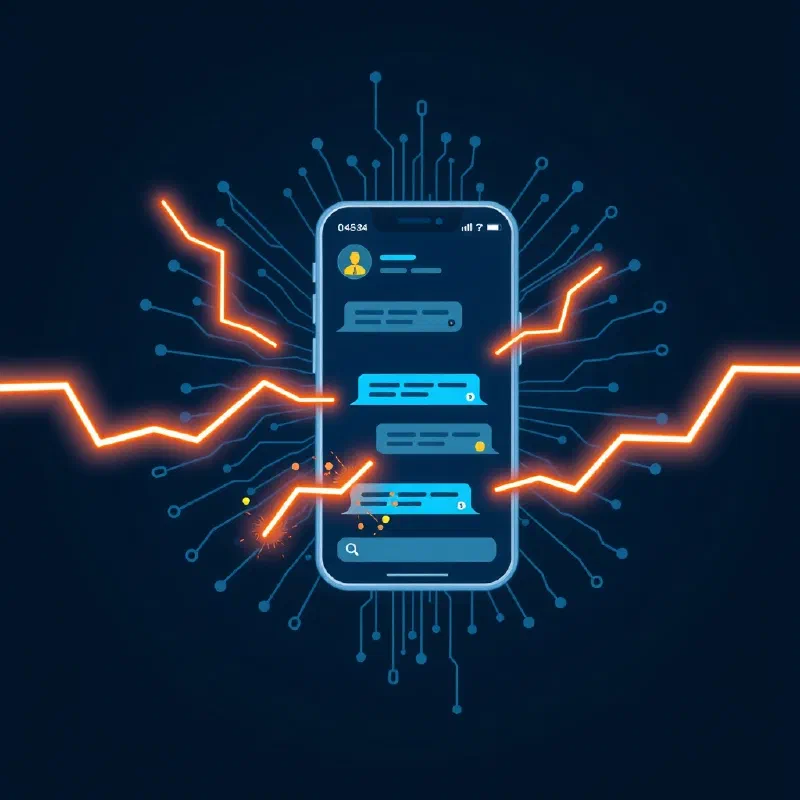
Signal — Blocking Artificial Intelligence Agents to Prevent Screen Exfiltration
Publication date: November 22, 2026
Category: AI attacks (LLM/LocalAI)
Introduction
The organization behind the encrypted messaging application Signal has announced technical restrictions designed to prevent new artificial intelligence agents integrated into mobile operating systems from reading content displayed on the screen. Initially reported by Security Affairs, this move comes in response to the growing integration of native intelligent assistants within environments like iOS and Android, which continuously scan visible content to assist the user. This dynamic poses a structural challenge for privacy-focused applications, as it exposes decrypted messages before the application’s cryptographic protection mechanisms can intervene.
What is the Conflict Between AI Agents and End-to-End Encryption? (General Analysis)
The core issue stems from a paradigm shift in the architecture of modern operating systems. Solutions such as Google Gemini Intelligence and Apple Onscreen Awareness with Siri AI operate with elevated system-level privileges, designed to capture and process on-screen content (Onscreen Awareness) to provide automated context for user requests.
From an information security perspective, this behavior introduces a significant risk conceptually classified within access control weaknesses and sensitive data exposure (estimated CWE-200: Exposure of Sensitive Information to an Unauthorized Actor). Even though the application maintains robust open-source, audited end-to-end encryption (E2EE), message data must be rendered in the device’s screen buffer for the user to read it. At that precise moment, an AI agent with screen capture permissions can intercept the information, store it in local databases, or transmit it to remote servers controlled by third parties, completely bypassing Signal’s trust model.
- Estimated CVSS Vector: CVSS v3.1 6.5 (Medium) — Vector:
AV:L/AC:L/PR:H/UI:N/S:U/C:H/I:N/A:N(Reasoned estimation based on privileged local access to sensitive on-screen data).
How Does It Work? (Technical Analysis)
Analysis of the behavior of these systems reveals a series of complex interactions between the application layer and operating system APIs:
- Screen Capture and Visual Access Flow: Integrated AI agents use hooks at the UI framework level and operating system accessibility services to perform periodic or on-demand captures of the graphics buffer (SurfaceFlinger on Android or equivalent frameworks on iOS).
- Persistence and Cloud Processing: Once the plain text of Signal messages is visually captured by the agent, the information is processed by local Large Language Models (LLMs) or transmitted to remote telemetries for contextual analysis, often stored in persistent caches outside the application developer’s control.
- Evasion of Traditional Controls: Unlike manual screenshots taken by the user (which already featured blocks via flags such as
FLAG_SECUREon Android), new agents operate via automated assistance APIs and advanced accessibility permissions (such as Meta Muse), which are designed to operate cross-sectionally across the entire device ecosystem.
Affected Systems / Environments
The impact of this OS-level AI integration primarily affects the following environments and platforms:
- Android Devices: Operating systems executing deep integrations with AI-based assistants (Google Gemini Intelligence) capable of scanning the screen in real-time.
- iOS Devices: Recent versions of Apple’s mobile operating system (including references to iOS 27 in the original report) equipped with Onscreen Awareness capabilities.
- Desktop Systems (macOS / Windows): Environments where the lack of granular APIs prevents developers from effectively blocking screen captures without compromising the general user experience (as previously evidenced with Microsoft Recall on Windows).
- Impacted Organization Profiles: Corporate and individual users who depend on Signal’s confidentiality on managed mobile devices (BYOD or corporate) where system AI assistants are enabled by default.
Mitigation and Detection
Remediation
Signal has implemented limited-scope specific mitigations consisting of enabling screen capture blocks on iOS and restricting screen reading attempts by AI assistants on Android. However, the following complementary actions are recommended:
- Manual Deactivation of AI Assistants: In the operating system settings, disable screen scanning and Onscreen Awareness features associated with assistants such as Gemini or Siri.
- Accessibility Permission Review: Audit third-party applications (such as Meta Muse or other automation tools) holding elevated accessibility permissions on the device.
- Development Policy Updates: Operating system platforms must heed Signal’s demands by providing granular APIs that allow sensitive application developers to explicitly block access to on-screen data, notifications, and file systems by AI agents.
Detection
Blue Teams in enterprise environments must actively monitor the behavior of managed mobile devices using mobile EDR/MDR solutions:
- Accessibility API Monitoring: Continuous auditing of services requesting accessibility permissions to interact with encrypted messaging graphical interfaces.
- Network Traffic Inspection: Detection of anomalous data exfiltration patterns toward endpoints associated with generative AI services from devices handling confidential information.
“We all need to recognize that the current integration of AI agents into the operating system, without these common-sense remedies, represents an existential threat to privacy at the application layer, and the ability of independent developers like Signal to protect your sensitive data.”
Wrapping Up
Signal’s decision to actively block AI agents highlights a systemic vulnerability in the architecture of current mobile operating systems. As platforms integrate intelligent assistants with full access to on-screen visual content, end-to-end encryption in messaging applications is undermined at the final rendering point. This scenario demands regulatory and technical change from tech giants to ensure user privacy is not sacrificed for AI-driven automation.
References
- Security Affairs. (2026, November 22). Signal Is Blocking AI Agents From Reading Your Screen. https://securityaffairs.com/?p=203742