
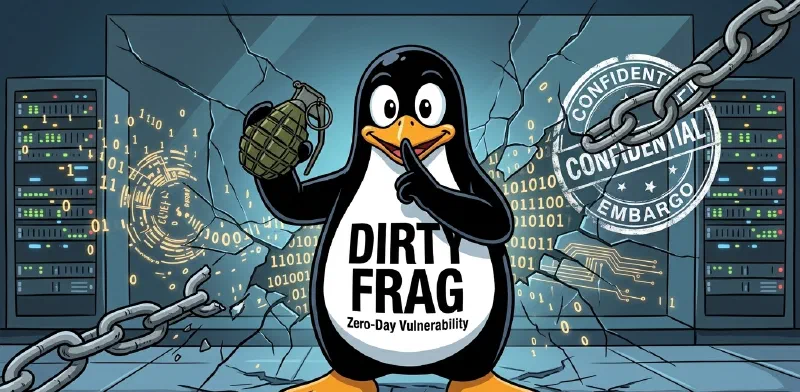
Dirty Frag: the vulnerability that can grant root access on any Linux system
Publication date: May 7, 2026 Category: Information Security · Linux · Vulnerabilities
Context: What happened?
On May 7, 2026, security researcher Hyunwoo Kim publicly disclosed a critical vulnerability in the Linux kernel, dubbed Dirty Frag. It is a Local Privilege Escalation (LPE) flaw — an attack that allows any user with basic access to a Linux system to escalate their permissions and gain full control of the machine as root.
What makes this case particularly sensitive is the way it became public: Kim had scheduled a coordinated and responsible disclosure for May 12, 2026, in order to give kernel developers and Linux distributions time to prepare patches. However, an unidentified third party leaked the exploit details before the agreed deadline, breaking the embargo. Faced with this situation, and after consulting with the maintainers of [email protected], Kim decided to immediately release all technical information so that system administrators could take preventive action.
At the time of public disclosure, no official patches or assigned CVE number existed for this vulnerability.
The Problem: Why is it so dangerous?
Dirty Frag is not an isolated vulnerability: it chains two separate kernel flaws to achieve its goal. The core mechanism relies on an out-of-bounds write through ordinary network sockets, specifically via the xfrm-ESP Page-Cache Write mechanism — the same entry point exploited by the previous vulnerability known as Copy Fail.
Its danger lies in several combined factors:
- Universality: It affects all major Linux distributions (Ubuntu, Debian, Fedora, Arch Linux, among others), regardless of their configuration.
- Immediacy: The exploit allows root privileges to be obtained almost instantly once executed locally.
- Bypassing prior defenses: Dirty Frag is able to circumvent the main mitigation deployed after Copy Fail — blacklisting the
algif_aeadmodule — rendering defenses already in place on many systems ineffective. - No patches available: With the embargo broken prematurely, the vulnerability went public with no fixes available for any distribution.
The kernel modules involved are esp4, esp6, and rxrpc, related to network protocols such as IPSec (used in virtual private networks).
Analysis: A reminder of the fragility of responsible disclosure
The Dirty Frag case brings to the forefront a debate that periodically shakes the cybersecurity world: how reliable is the coordinated disclosure model?
Researcher Hyunwoo Kim followed the correct procedure: he discovered the vulnerability, notified the kernel maintainers, and agreed on an embargo period to allow patches to be developed before making the finding public. This process, known as responsible disclosure, is the industry standard and is designed to protect users during the window of time needed to develop solutions.
However, the leak by an unidentified third party — whose identity and motivations remain unknown at the time of this publication — turned millions of systems into potential targets with no remedy available. This is a scenario experts call a public zero-day, and it represents the worst possible outcome for any well-intentioned security researcher.
This incident is also a reminder that the Linux ecosystem, while widely regarded as robust and secure, is not immune. The kernel is an enormously complex piece of software that is constantly evolving, and the interaction between its components can generate unexpected attack vectors, even in seemingly peripheral modules such as those handling network protocols.
Available Mitigations: What can you do right now?
In the absence of official patches, the kernel maintainers and Kim himself have published a temporary mitigation consisting of disabling the vulnerable modules. If you manage Linux systems, you can run the following command with superuser privileges:
sh -c "printf 'install esp4 /bin/false\ninstall esp6 /bin/false\ninstall rxrpc /bin/false\n' > /etc/modprobe.d/dirtyfrag.conf; rmmod esp4 esp6 rxrpc 2>/dev/null; true"⚠️ Warning: This mitigation may disrupt active IPSec tunnels. If your infrastructure relies on IPSec (for example, for corporate VPNs), assess the impact before applying it. Additionally, a system reboot or cache flush is required for the changes to take full effect.
Security Tips for Administrators and Users
Beyond the immediate mitigation, this incident is an opportunity to reinforce security practices in any Linux environment:
For system administrators
- Apply the temporary mitigation immediately if your systems do not depend on IPSec, while waiting for official kernel patches.
- Actively monitor security channels: Subscribe to mailing lists such as
[email protected]and follow sources like LWN.net or the OpenWall project to receive early alerts. - Limit loaded kernel modules: A kernel compiled with only the strictly necessary modules dramatically reduces the attack surface. Consider auditing which modules are currently active on your systems.
- Implement the principle of least privilege: Ensure that regular users do not have access to tools or capabilities they do not need for their work.
- Maintain an incident response plan: When facing zero-day vulnerabilities, response time is critical. Having predefined procedures speeds up the reaction.
For general Linux users
- Update your system regularly: As soon as patches become available, apply them without delay. Most distributions will deliver them through their package managers (
apt,dnf,pacman, etc.). - Do not share access to your machines with unauthorized individuals, as this vulnerability requires local access to the system.
- Follow reliable security news sources to stay informed about vulnerabilities that may affect you.
Incident Timeline
| Date | Event |
|---|---|
| Before May 7, 2026 | Hyunwoo Kim discovers Dirty Frag and coordinates embargo until May 12 |
| May 7, 2026 | An unidentified third party publishes exploit details, breaking the embargo |
| May 7, 2026 | Kim releases all technical information, the exploit, and the mitigation via oss-security |
| May 7, 2026 | LWN.net, Hacker News, and the security community spread the alert |
| Pending | Release of official patches by Linux distributions |
Wrapping up…
Dirty Frag is an uncomfortable but necessary reminder: no operating system, no matter how mature or widely used, is immune to fundamental security flaws. What sets this case apart is not only the technical severity of the exploit — which is considerable — but the breakdown of a disclosure process that was designed to protect users. The broken embargo left millions of systems exposed without a patch available, turning a responsible finding into a window of opportunity for malicious actors.
The response, as always, combines immediate technical action — applying the available mitigation — with a posture of continuous vigilance: following official channels, reducing the attack surface, and updating systems as soon as patches arrive. Security in Linux is not a state; it is a process.
Sources consulted:
- Kim, H. (V4bel). “Dirty Frag: Universal Linux LPE” — oss-security, OpenWall (May 7, 2026)
- Kim, H. (V4bel). Dirty Frag repository and technical write-up — GitHub (2026)
- LWN.net Staff (jzb). “Dirty Frag: a zero-day universal Linux LPE” — LWN.net (May 7, 2026)
- SecLists / oss-sec Archive. “Dirty Frag: Universal Linux LPE” — seclists.org (2026)
- nixCraft. “Dirty Frag: Universal Linux LPE” — Mastodon Social (May 7, 2026)
- Hacker News Community. “Dirtyfrag: Universal Linux LPE” — Y Combinator (May 7, 2026)
- Lobsters Community. “Dirty Frag: Universal Linux LPE” — Lobste.rs (May 7, 2026)