
USBLiter8: When a USB Cable Is Enough to Break a Chip’s Secure Boot
Classification: High-severity vulnerability — Chain of trust compromise / Unsigned code execution Public disclosure date: June 18, 2026 Researchers: Paradigm Shift
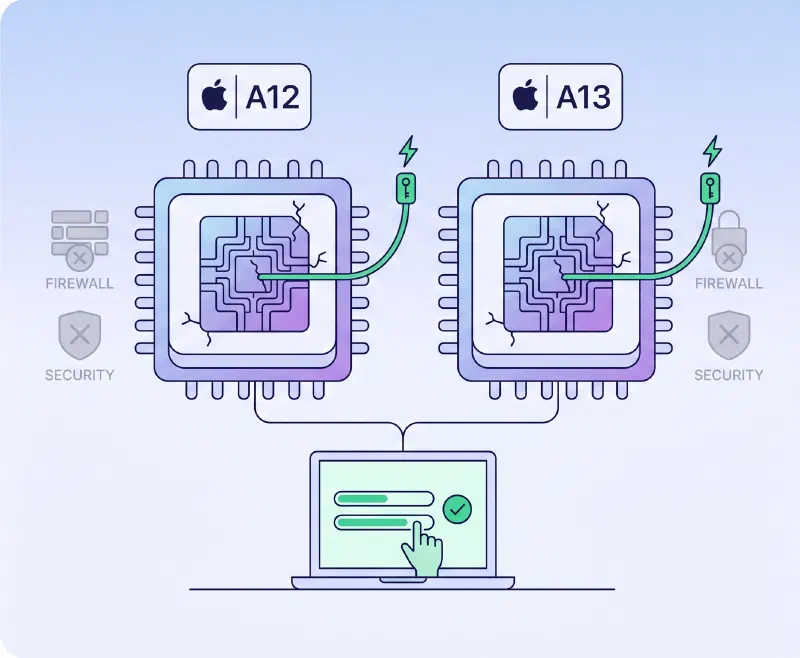
Security research firm Paradigm Shift has publicly disclosed an exploit called USBLiter8, capable of executing arbitrary code within the SecureROM (BootROM) of Apple’s A12 and A13 chips, as well as the S4 and S5 SoCs used in the Apple Watch. Unlike the vast majority of vulnerabilities covered in this space, the flaw doesn’t live in a line of code that can be fixed with an update: it’s permanently etched into the silicon during chip manufacturing.
The problem in one line
Anyone with physical access to one of these devices, a USB cable, and a low-cost microcontroller board could, in under two seconds, execute their own code within the very first link of the secure boot chain. No prior jailbreak. No software exploits. No future update can ever reverse it.
That’s USBLiter8.
What is USBLiter8 and why does it matter?
In everyday terms, secure boot is the mechanism that ensures a device only runs software verified and signed by the manufacturer from the moment it powers on. That guarantee is built as a chain: the first code that runs — the SecureROM or BootROM — verifies the next link, and so on, all the way up to the full operating system.
The USBLiter8 flaw sits precisely in that first link: a design defect in the Synopsys DWC2 USB controller, integrated directly into the processor. When a device enters DFU (Device Firmware Update) mode — the low-level recovery state normally used to reinstall firmware — the controller mishandles certain USB Setup packet sequences, allowing an attacker to manipulate internal memory structures before any signed software ever loads.
What makes this case especially notable — beyond its technical severity — is that the flawed code lives in read-only memory burned in at the factory. Apple can patch flaws in iOS, iPadOS, or watchOS through software updates; it cannot patch the SecureROM of a chip that has already left the production line. This illustrates a pattern distinct from traditional software security: when the defect is in the hardware, the only complete mitigation is replacing the hardware itself.
How does the flaw work?
To understand the vulnerability, it helps to understand the role SecureROM plays in these devices.
SecureROM is the first code executed when the chip powers on: it cryptographically verifies the next boot component (iBoot) before handing it control. By design, it’s the component that the security of everything afterward depends on. To keep it immutable and tamper-resistant, it’s etched directly into the silicon at the time of manufacture.
USBLiter8 exploits an inconsistency in how that code manages memory during low-level USB operations:
Step 1 — Entering DFU mode and physical connection. The target device is manually placed into DFU mode and connected via USB to a microcontroller board based on the RP2350 (for example, the Waveshare RP2350 USB-A/Zero, Pimoroni TINY2350, or Raspberry Pi Pico 2), capable of generating low-level USB traffic that conventional host stacks don’t produce.
Step 2 — Manipulating the USB negotiation. The board sends a sequence of consecutive USB Setup packets designed to confuse the DWC2 controller during the initial connection negotiation phase.
Step 3 — Boot process memory corruption. On A12 chips, the DMA buffer sits contiguous to the heap-managed stack of the USB-handling process; overwriting a saved link register hands over control of the program counter at the next context switch. On A13 chips, protected by Pointer Authentication (PAC), the bypass requires additional stages: corruption of DART-related heap structures, manipulation of the panic-depth counter to prevent automatic reboots, and timed overwriting of the USB interrupt handler pointer in the BSS section.
Step 4 — Privileged execution inside SecureROM. With memory structures already corrupted, the next USB interrupt event executes the attacker’s code in privileged mode (EL1), inside SecureROM itself, before the signed boot chain ever loads.
Exploitation requires no prior jailbreak, no additional software on the device, and no remote access. A vulnerable device, physical possession, a cable, and the right board are all that’s needed. Notably, the exploit does not directly compromise the Secure Enclave: users’ encrypted data and passcodes remain, in principle, protected — though researchers warn that a compromise this deep could open additional paths toward that subsystem.
Which systems are affected?
The impact of USBLiter8 is limited to devices that integrate the DWC2 controller together with the hardware-protection configuration present in these silicon generations:
- iPhone: XS, XS Max, XR, second-generation SE, and the entire iPhone 11 line.
- iPad: models equipped with the A12 chip, including A12X/A12Z variants (with latent but unimplemented technical support).
- Apple Watch: models with S4 and S5 SoCs.
- Other devices sharing the same SoC: Studio Display, HomePod mini, and the second-generation Apple TV 4K.
Not affected:
- Devices with A11 chips or earlier, due to different USB controller behavior.
- Devices with A14 or later, since they correctly configure the DART (Device Address Resolution Table) subsystem, neutralizing the exploitation technique known to date.
The minimum exploitation requirements — physical possession of the device, manually activated DFU mode, and a specific piece of hardware — limit its use to targeted scenarios: temporary custody by third parties, border control checkpoints, lost or stolen devices, or compromised supply chains.
Why are hardware flaws the hardest threat to eradicate?
USBLiter8 belongs to a rare but especially feared family of vulnerabilities in the industry: BootROM flaws, for which there are barely any public precedents — the best known, checkm8, exposed even older Apple hardware back in 2019.
The reason for their rarity is also the reason for their severity. BootROM code is exhaustively validated before it’s burned in because, unlike any other layer of the system, it gets no second chance: once the chip is manufactured, that code is final. When a defect appears anyway, there’s no patch possible — only the option to change the protection configuration in future silicon generations, as happened with A14 versus A12/A13.
The finding also carries a notable methodological implication: until now, exploiting SecureROM required significant research resources. The fact that a team outside Apple managed to break it using commercially available microcontroller hardware — rather than specialized lab instrumentation — lowers the barrier to entry for this kind of research, which will likely drive similar findings on other chip families in the future.
Security recommendations
In this case, the most important measure is the opposite of the usual one: there is no update that fixes the flaw. Recommendations focus on controlling physical access and managing hardware lifecycle.
For users and fleet administrators
| Scenario | Recommended measure |
|---|---|
| Corporate A12/A13 devices in active use | Strengthen physical custody policies and restrict access by unauthorized third parties |
| Devices at public or shared charging stations | Use USB data blockers (“USB condoms”) that allow only power to pass through |
| Devices requiring technical support involving DFU mode | Perform the procedure only at authorized service centers and under supervision |
| High-sensitivity environments (government, finance, healthcare) | Prioritize migration to A14 or later hardware |
| Lost, stolen, or third-party-recovered devices | Treat as potentially compromised and consider replacement before returning them to operation |
Wrapping up…
USBLiter8 is a BootROM-type exploit that allows unsigned code execution within the SecureROM of Apple’s A12, A13, S4, and S5 chips, via a physical defect in the DWC2 USB controller exploited with physical access to the device in DFU mode.
The flaw was disclosed by Paradigm Shift, which notified Apple Product Security before publication, and lies in how the controller processes consecutive USB Setup packets during boot. Its impact reaches the iPhone XS through iPhone 11, certain iPad models, Apple Watch S4/S5, and devices sharing the same chipset.
Key takeaways:
- The attack vector requires physical access: it is not remotely exploitable.
- The flaw is permanent: no future software can fix it on devices already manufactured.
- The Secure Enclave is not directly compromised, though it could represent an additional attack path.
- The only complete mitigation is hardware replacement; everything else is physical containment and access-control measures.
- The precedent matters: it’s the first public unpatchable BootROM flaw since checkm8 in 2019, and likely won’t be the last of its kind.
USBLiter8 doesn’t change the day-to-day risk for most users — the attack demands physical possession and deliberate manipulation — but it is a reminder that when trust fails at the hardware level, no software layer above it can fully make up for it.
References
- The Hacker News. (2026, June 19). Unpatchable usbliter8 exploit breaks Apple A12 and A13 SecureROM boot chain. thehackernews.com/2026/06/unpatchable-usbliter8-exploit-breaks.html
- AppleInsider. (2026, June 18). A12 & A13 Apple devices face an unpatchable SecureROM vulnerability. appleinsider.com/articles/26/06/18/a12-a13-apple-devices-face-an-unpatchable-securerom-vulnerability
- iClarified. (2026, June 18). Unpatchable BootROM exploit ‘usbliter8’ released for iPhone XS through iPhone 11. iclarified.com/101232/unpatchable-bootrom-exploit-usbliter8-released-for-iphone-xs-through-iphone-11
- Gadget Hacks. (2026, June 19). Unpatchable iPhone exploit A12 A13 chips: usbliter8 explained. apple.gadgethacks.com/news/unpatchable-iphone-exploit-a12-a13-chips-usbliter8-explained
- Hollington, J. (2026, June 18). New exploit exposes permanent flaw on older iPhones. iDropNews. idropnews.com/news/new-exploit-permanent-iphone-flaw-usbliter8/265319